Unlike credit cards or personal loans, technical debt doesn’t appear on any bank statement. There is no clear figure, no automatic alerts, and often, there isn’t even an awareness that it exists… until it starts to hurt.
In the best-case scenario, this debt is taken on consciously: it’s documented with a TODO, a task is created in the backlog, or a record is left stating that “this will need to be fixed later.”
But all too often, that documentation isn’t generated “because there’s no time.” Or even worse: you aren’t even aware that you’re borrowing.
And just like any debt, the interest accumulates.
The problem isn’t having technical debt—it’s inevitable in any real-world project—it’s not knowing you have it until it blocks you.
Clear Signs of Technical Debt
These are some of the most common (and dangerous) ways to detect it.
1. Audits That Uncover More Than Expected
A technical audit—internal or external—is usually the first point of contact with reality. You don’t just find style issues or minor improvements; you find repeated patterns of coupling, temporary workarounds that became permanent, and decisions that no one remembers why they were made.
If an audit generates a long list of “we should probably…” it’s a clear red flag.
2. Every New Feature Costs More Than the Last
When adding a small feature requires touching many parts of the system, coordinating multiple deployments, or spending more time on “not breaking anything” than on delivering value, the system is paying interest.
Technical debt slows down delivery speed progressively, almost imperceptibly at first.
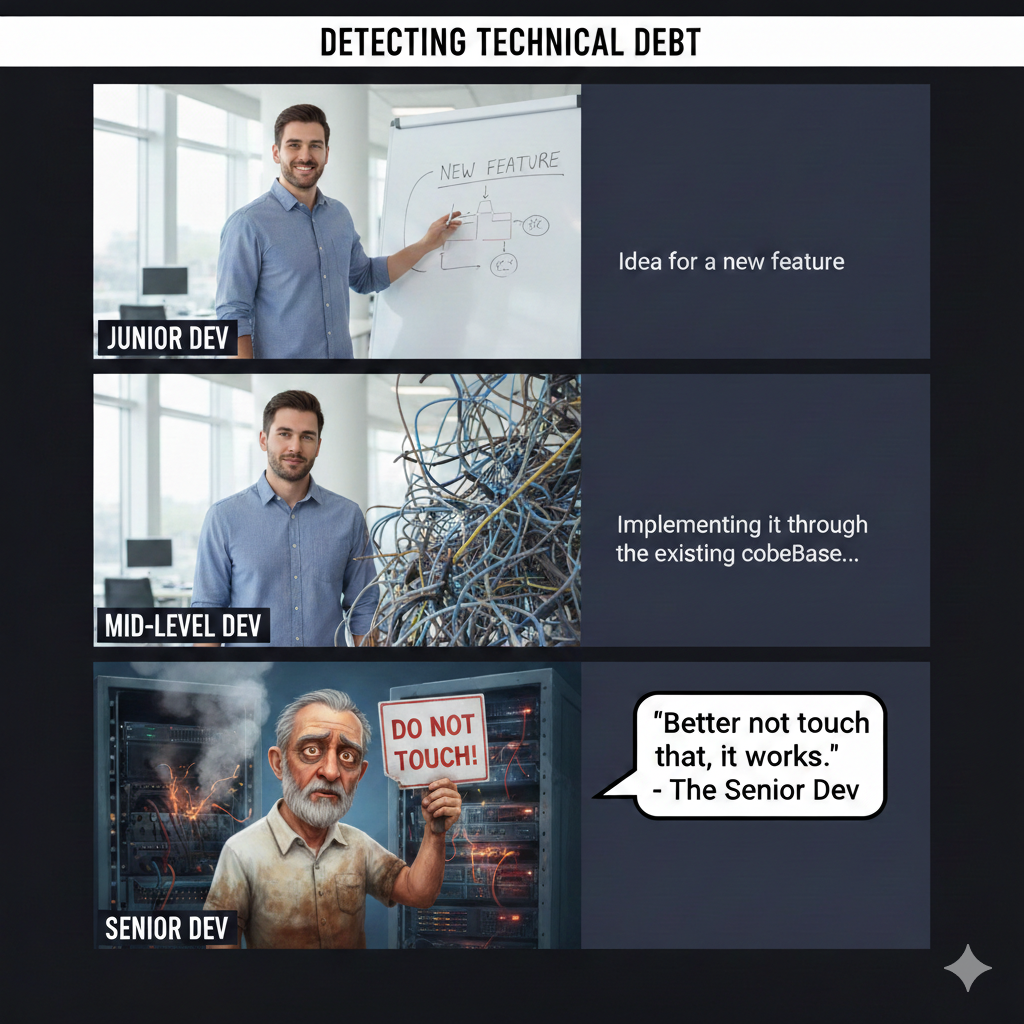
3. Fragile Code: Touching One Thing Breaks Another
Seemingly innocuous changes that cause unexpected side effects are a classic symptom. The code stops being local: you can’t reason about one part without thinking about the entire system.
This is where the phrase usually appears:
“Better not touch that, it works.”
4. The Code Starts to Feel Scary
When working on a codebase becomes unpleasant, stressful, or creates a sense of dread, something is wrong.
It’s not just an aesthetic issue. It’s a sign that accidental complexity has overtaken the complexity of the actual problem.
5. Reluctance to Update Infrastructure
Updating versions of libraries, SDKs, or frameworks meets resistance: “Better not touch it,” “we’ll see,” “it’s not a priority right now.”
This usually indicates brittle coupling, poorly managed dependencies, or a lack of tests that provide confidence. The result is technological stagnation, potential security issues… and more debt.
6. Non-existent or Irrelevant Tests
The absence of tests—or the presence of tests that don’t catch real errors—removes any safety net.
Without useful tests:
- Changes are slower.
- The fear of breaking things increases.
- Maintenance costs skyrocket.
Technical debt isn’t just in the code; it’s also in what was never validated.
Detect Before It Blocks
Technical debt doesn’t appear all at once. It creeps in bit by bit, decision by decision, sprint by sprint.
Detecting it in time allows you to:
- Prioritize refactoring with clear criteria.
- Make conscious technical decisions.
- Prevent the system from becoming a handbrake for the business.
Ignoring it doesn’t make it go away. It only makes it more expensive.
Need help reining in your technical debt?